By Martin Osei Tutu, Accra
Ghana must move beyond policy commitments to action on climate change and Environmental, Social and Governance principles, ministers told the Ghana National Climate and ESG Policy Summit 2026 in Accra.
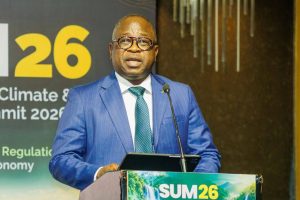
The Summit, dubbed SUM 26, was held at the Movenpick Ambassador Hotel under the theme Decoding Policy and Regulation for the Next Economy. The 2026 focus was Aligning the Private Sector with Ghana’s Green Transition Framework. It was held under the auspices of the Office of the Minister of State for Climate Change and Sustainability, Issifu Seidu, and convened by Intelligence Nature International.
Welcoming participants, the Chief Executive Officer of Intelligence Nature International, Dr William K. Bannerman, set the context and said the Summit was convened to move Ghana from dialogue to practical decisions.
Declaring the Summit open, Mr Seidu said the theme was both timely and strategic. Policies must not remain confined to government documents or international declarations. They must be translated into guidance, institutional action, investment decisions and measurable improvements in people’s lives, he said.
He said the next economy will reward countries and businesses that combine competitiveness with climate resilience and credible sustainability performance. Ghana has made commitments under the Paris Agreement and its Nationally Determined Contributions, but commitments alone do not deliver transformation. Their value depends on how effectively they are integrated into national priorities and private-sector decisions.
He said the Summit must deliver more than an exchange of ideas. It must identify changes to make Ghana’s climate and ESG policy environment more coherent, accessible and investment-friendly.
Let us be frank about the challenges, he said. Where regulations overlap, better coordination should be recommended. Where viable projects struggle to secure finance, ways should be found to make them investment-ready. Where global developments such as COP31 and CBAM create risks or opportunities, Ghana should be prepared to respond strategically.
In his keynote address, the Minister for Local Government, Chieftaincy and Religious Affairs, Mahama Ayariga, said climate change is no longer a distant concern. It is a present reality affecting livelihoods, food security, water and economic stability.
The integration of ESG principles into national policies and private-sector operations is not merely compliance. It is a strategic imperative for promoting responsible investment, strengthening accountability and protecting natural resources, he said.
As a nation, we must shift from policy commitments to practical action, he said. This requires stronger coordination, effective implementation, increased mobilisation of sustainable finance, and partnerships with the private sector and civil society.
Much of that action will happen at the local level. It is in our districts that the effects of climate change are felt first, in flooding, drought, pressure on land and water, and threats to farming. It is also in our districts that national commitments must become results. Our Assemblies are therefore at the frontline of Ghana’s climate response, he said.
He said climate action must be inclusive and responsive to vulnerable communities, women and young people. He welcomed the National Communique and said his Ministry will work with Assemblies to carry forward.