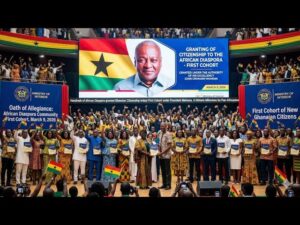
Vice President Prof. Jane Naana Opoku-Agyemang has described Ghana’s citizenship conferment ceremony for members of the African diaspora as a powerful moment of historical restoration and reconnection rather than merely a legal process.
Speaking at the event held at the Accra International Conference Centre, the Vice President said the ceremony symbolized Ghana’s enduring commitment to reconnecting with descendants of Africans who were displaced through the transatlantic slave trade.
“Today is not simply a legal ceremony. Today is a declaration that history may scatter a people, but it cannot erase their identity,” she said while addressing newly sworn-in Ghanaian citizens from the diaspora.
According to her, the occasion represents more than the granting of nationality, emphasizing that it embodies healing, restoration, and the rebuilding of ties between Africa and its global descendants.
Prof. Opoku-Agyemang noted that the government, under the leadership of President John Dramani Mahama, continues to advocate internationally for the formal recognition of the transatlantic slave trade as one of the gravest crimes against humanity.
She revealed that Ghana is leading diplomatic efforts at the United Nations to ensure that the historical injustice receives global acknowledgment as part of a broader commitment to truth, remembrance, justice, and restoration for people of African descent.
The Vice President reflected on the painful history of the slave trade, pointing to the dungeons of Cape Coast and Elmina Castles as enduring reminders of a tragic past when millions of Africans were forcibly removed from the continent.
Despite that history, she said the descendants of those who endured the Middle Passage have demonstrated extraordinary resilience, creativity, and cultural brilliance across the world.
Quoting President Mahama’s recent remarks, she said people of African descent across the globe remain “branches of the same ancestral tree,” bound by a shared history and a collective destiny.
Prof. Opoku-Agyemang emphasized that Ghana’s commitment to the diaspora is rooted in the vision of the country’s founding President, Osagyefo Dr. Kwame Nkrumah, who envisioned Ghana as a gateway for unity and progress for Africans everywhere.
She added that Ghana’s independence in 1957 was meant to inspire freedom and opportunity not only for the nation itself but also for Africans and people of African descent around the world.
The Vice President further highlighted the immense contribution of the African diaspora to the continent, noting that diaspora communities provide billions of dollars annually to African economies through remittances, investments, entrepreneurship, and philanthropy.
She stressed that while these economic contributions are significant, Ghana’s relationship with the diaspora must go beyond financial engagement to focus on identity, belonging, and shared destiny.
To deepen these ties, she said the government is strengthening a comprehensive Diaspora Engagement Policy aimed at transforming historical connections into practical partnerships.
The policy, she explained, seeks to create new pathways for diaspora investment, promote entrepreneurship, expand cultural exchanges, and encourage diaspora participation in education, innovation, tourism, and national development.
“Our goal is to build a Ghana where Africans everywhere—whether on the continent or in the diaspora—can contribute meaningfully to our shared prosperity,” she said.
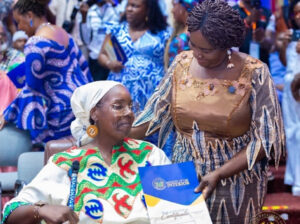
Addressing the newly naturalized citizens, the Vice President told them that Ghana welcomes them not as strangers but as family.
She urged them to see their citizenship not only as a nationality but also as a commitment to belonging, responsibility, and partnership in Ghana’s development journey.
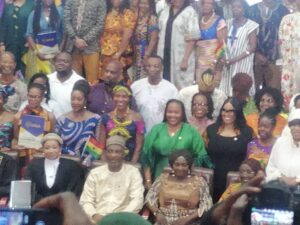
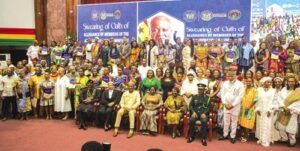
The ceremony brought together government officials, members of the diplomatic corps, and representatives of diaspora communities to witness what the Vice President described as a celebration of homecoming.
“Today, therefore, we celebrate not only citizenship; we celebrate homecoming,” she concluded, welcoming the new citizens in multiple Ghanaian languages with the words: “Akwaaba, Woezor, and Obaake.”