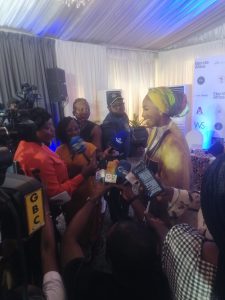
Her Majesty Olori Atuwatse III, Co-founder of Elevate Africa, has called on African leaders and citizens to build confidence in homegrown solutions, strengthen leadership and empower the continent’s youthful population to shape Africa’s future.
She said Africa’s development challenges were not necessarily due to a lack of solutions but rather insufficient confidence in the continent’s existing capabilities and limited efforts to harness them effectively.
Speaking at the pre-convening press conference for the Elevate Africa Annual Convening 2026 in Accra, the Queen Consort of the Warri Kingdom said Africans must move away from narratives that portray the continent primarily through its problems and instead amplify the innovations, talent and initiatives capable of driving sustainable development.
“Elevate Africa exists from a sole conviction that Africa doesn’t lack solutions. What we lack is the conviction and the confidence in the solutions that we already have,” she said.
She explained that Elevate Africa was established to help change the continent’s development narrative through advocacy, collaboration and talent development, emphasising that African countries must take greater ownership of their development priorities.
Olori Atuwatse III outlined three key areas underpinning the organisation’s work: advocating for African solutions, convening leaders to exchange ideas and develop practical responses to shared challenges, and nurturing talent capable of transforming the continent.
She said the organisation deliberately brings together leaders from governments, businesses and other sectors because sustainable solutions cannot be developed in isolation.
According to her, collaboration across institutions and sectors is essential to identifying opportunities, sharing successful experiences and translating ideas into practical outcomes.
The Elevate Africa co-founder also highlighted the importance of investing in the continent’s young people, noting that Africa’s youthful population represents an enormous resource for its future development.
She said the organisation’s fellowship programme supports mid-career professionals from across Africa and the diaspora, helping them develop transformational leadership skills, reshape narratives about the continent and cultivate innovative approaches to solving problems.
“We cannot elevate Africa independent of her talent,” she stressed.
She explained that the fellowship seeks to equip participants to challenge negative perceptions of Africa and recognise their responsibility in shaping the continent’s future through their leadership, communication and professional contributions.
Explaining why Ghana was selected to host the 2026 convening, Olori Atuwatse III pointed to the country’s historic contribution to Pan-Africanism and its longstanding role in bringing Africans and members of the diaspora together.
She recalled Ghana’s independence in 1957 and the vision of its first President, Dr Kwame Nkrumah, who linked the country’s liberation to the freedom of the entire African continent.
She described Ghana as a forerunner nation whose historical contributions continue to provide a foundation for conversations about African unity, identity and development.
She also highlighted Ghana’s Year of Return initiative and its efforts to strengthen relations with the African diaspora, as well as the country’s role in promoting reparatory justice and hosting the Secretariat of the African Continental Free Trade Area (AfCFTA).
According to her, these milestones demonstrate why Accra provides an important setting for discussions on how Africans can collectively determine their future.
Olori Atuwatse III said the convening was taking place at a critical moment when Africa had an opportunity to take greater control of its development agenda and redefine how the continent was perceived globally.
She referenced changing international conversations about Africa, including renewed attention to the continent’s true geographical size, as an opportunity for Africans to reconsider their place in the world and assert greater ownership of their future.
She expressed appreciation to the Ghanaian government, particularly the Office of the President’s Diaspora Affairs Office, for its partnership and support for the event.
The 2026 convening is expected to bring together African leaders, policymakers, business executives, innovators and members of the diaspora to explore opportunities for collaboration and development.
In his welcome address, Dr Rex Odaminabo, Chief Partnership Officer of Elevate Africa, said the continent needed stronger connections between its resources, capital, leadership and opportunities to translate its enormous potential into tangible progress.
He noted that Africa possessed abundant natural resources, a youthful population and entrepreneurs developing solutions to various challenges.
However, he argued that the critical task was to connect these assets with the investments, partnerships and leadership required to deliver meaningful results.
Dr Odaminabo said the theme, “Africa: Defining Our Future,” was more than a conference slogan but a call for Africans to take responsibility for shaping the continent’s destiny.
He called for stronger partnerships among governments, investors, businesses, innovators and communities, urging stakeholders to move from discussions to commitments, investments and measurable impact.
He also appealed to the media to report Africa’s progress accurately and responsibly while amplifying the voices of those working to build the continent.
Mr Kofi Okyere Darko, Director of Diaspora Affairs at the Office of the President, welcomed the organisers and participants to Accra, describing Ghana as an important centre for Pan-African engagement and efforts to unite Africans on the continent and in the diaspora.
Representing the Office of the President, he highlighted President John Dramani Mahama’s advocacy for reparatory justice for people of African descent.
He recalled the historic connections between Ghana and prominent figures in the Pan-African movement, noting that personalities such as Dr Martin Luther King Jr., Malcolm X, Muhammad Ali and Dr W.E.B. Du Bois had connections to the country’s broader Pan-African story.
Mr Okyere Darko also discussed Ghana’s efforts to deepen engagement with members of the diaspora, including initiatives to facilitate citizenship for people of African descent who wish to make Ghana their home.
He explained that the government was seeking to place greater emphasis on individuals who demonstrated a sustained commitment to Ghana’s development, including those who had established businesses and contributed to the economy over the years.
He said the diaspora remained an important partner in advancing African unity and development, adding that the continent’s future could not be fully realised without its participation.
Prince Moses, Director of Strategy and Adviser to the Chairman of the Africa Prosperity Network (APN), who represented the network’s Founder and Executive Chairman, Gabby Asare Okyere Darko, said the future of African prosperity depended partly on removing barriers that hinder the movement of people, capital, goods and services across the continent.
Speaking on behalf of the organisation, he said Elevate Africa’s mission of enabling Africans to define their future aligned with APN’s efforts to close the gap between Africa’s development aspirations and the realities experienced by its people.
He identified restrictive visa arrangements, fragmented payment systems, licensing requirements and barriers to trade as obstacles to deeper African integration.
Prince Moses cited the continent’s population of more than 1.5 billion people and combined gross domestic product exceeding US$3.4 trillion as evidence of its significant economic potential.
However, he said intra-African trade remained comparatively low, despite the existence of frameworks such as the AfCFTA and the African Union’s Agenda 2063.
He called for the implementation of existing continental agreements to facilitate visa-free movement, improve cross-border payments and establish a more integrated digital market.
He also advocated the full operationalisation of the Pan-African Payments and Settlement System (PAPSS) and greater interoperability among mobile money platforms to reduce transaction costs and make cross-border business easier.
According to him, these measures would support entrepreneurs, investors and creative industry professionals by making it easier to move across the continent, receive payments and conduct business without unnecessary barriers.
Prince Moses further announced that APN would hold its fifth Africa Prosperity Dialogues from January 13 to 15, 2027, at the Kempinski Hotel in Accra, under the theme “Borderless Africa: Move Freely, Pay Seamlessly, Trade More.”
He said the event would build on ongoing efforts to advance African integration and turn existing policy commitments into practical outcomes.
The speakers collectively emphasised that Africa’s future would depend on its ability to mobilise its human and natural resources, strengthen partnerships, support innovation and implement policies that promote economic integration.
For Olori Atuwatse III and Elevate Africa, the immediate priority is to encourage Africans to recognise their capacity to develop solutions, strengthen their leadership and take ownership of the continent’s story.
The Elevate Africa Annual Convening 2026, scheduled for October 28 and 29 at the Mövenpick Ambassador Hotel in Accra, is expected to provide a platform for leaders and stakeholders to exchange ideas, forge partnerships and explore practical approaches to Africa’s development.
The central message from the pre-convening press conference was that Africa’s future must not be left to external forces to determine. Rather, Africans must work together to shape that future through confidence, collaboration, innovation and decisive action.