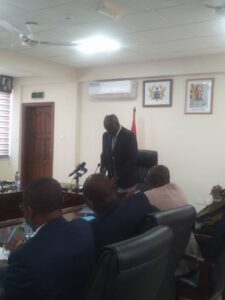
The Minister of Education, Hon. Haruna Iddrisu, has unveiled a sweeping set of reforms aimed at revolutionizing the teaching profession in Ghana. Speaking at the inauguration of the National Teaching Council (NTC) and the Chartered Institute of Bankers Council in Accra, he charged the newly sworn-in boards to drive transformation under the new Education and Revolutionary Bodies Act, 2023.
Representing President John Mahama, the Minister emphasized that the era of unregulated teacher training and fragmented licensure is over. He announced that the teacher licensing process will now go beyond paper-based exams to include supervised practical evaluations, structured mentorship, and a holistic assessment of classroom competence.
“This new model will ensure that our teachers are not just academically prepared, but professionally ready,” Hon. Iddrisu stated. “It is your duty to promote accountability, strengthen teacher-parent relations, and ensure that no child is left behind due to professional negligence or lack of discipline.”
In a passionate plea, the Minister also highlighted the critical role of teachers in shaping the future of learners. “When teachers guide well, learners learn and they become better people,” he declared, adding that collaboration among teachers, parents, and institutions must be prioritized.
Turning to the welfare of educators, Hon. Iddrisu proposed a national teacher housing initiative. Under this proposal, teachers could voluntarily contribute up to $200 monthly into a fund, to be matched by government support. These contributions would then be used as collateral through pension fund-backed schemes to build homes for teachers, especially in rural areas.
“We are in talks to use teachers’ pension funds as collateral for housing estates. This is the norm in other countries, and Ghana must do the same. Teachers deserve decent accommodation and dignity,” he said.
The Minister concluded with a call for urgency in finalizing outstanding licensing processes before the 13th of August 2025, promising that the reforms, once implemented, will restore public trust in the education system and uplift the teaching profession.