**Calls for Africa’s First Degree-Awarding Vocational Faculty as New UCC Vice-Chancellor Takes Office; Says Universities Must Reinvent or Become Irrelevant in AI Era**
By Daily Democrat News Desk
In what is being described as one of the most visionary and thought-provoking speeches ever delivered at a Ghanaian university, the Chancellor of the University of Cape Coast (UCC), Sir Sam Jonah has thrown down the gauntlet to higher education institutions across Africa, warning that the age of artificial intelligence has fundamentally changed the purpose of the university.
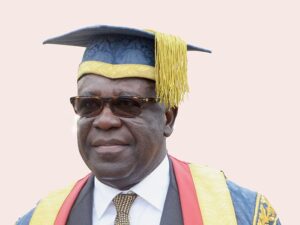
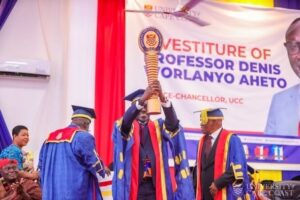
Speaking during the installation of Professor Aheto as the new Vice-Chancellor of UCC, the Chancellor declared that he was not handing over “keys” to the new university leader but “a storm”, a defining moment that will determine whether African universities remain relevant or become relics of a bygone era.
“For the first time in human history, the cleverest entity in the room may not be a person,” he declared to prolonged applause. “The scarcity of answers is over. We now live in the Age of Answers.”
Sir Jonah posed the defining question of the century: “What is a university for when the library talks back?”
According to him, artificial intelligence has made knowledge abundant, instant and nearly free, forcing universities to abandon the centuries-old model of merely transmitting knowledge and instead focus on producing graduates capable of solving problems, creating solutions and exercising sound judgment.
“If our answer is to transmit knowledge, then we are finished because machines now do that better, faster and cheaper. But if our mission is to form human beings who can do what no machine can do, then the university is about to enter its greatest century.”
**AFRICA MUST LEAD, NOT FOLLOW**
The Chancellor urged African universities to stop importing educational models designed elsewhere and instead build institutions rooted in African realities and capable of addressing the continent’s economic and social challenges.
“The future cannot be imported as a finished product. We must write it ourselves,” he declared.
Sir Jonah insisted that degrees must no longer be certificates proving that students can memorise information but must become evidence that graduates can innovate, build enterprises, solve practical problems and lead society.
**”A NATION OF CERTIFICATES CAN STILL BE POOR”**
Delivering one of the speech’s strongest critiques, the Chancellor lamented that many African graduates leave university armed with impressive academic credentials but lacking practical skills.
He described this as the tragedy of African education.
“We have graduates who can describe agriculture but cannot grow a tomato, define entrepreneurship but have never sold anything. Knowledge of a thing is not the ability to do the thing”, he said.
According to Sir Jonah, a nation whose citizens know but cannot perform practical tasks will remain “beautifully certificated, and poor.”
**REVOLUTIONARY PROPOSAL FOR UCC**
In what observers described as the speech’s most groundbreaking announcement, the Chancellor proposed that the University of Cape Coast establish Africa’s first
Faculty of Degree-Awarding Vocational Education.
The proposed faculty, according to Sir Jonah, would offer Bachelor’s and Master’s degrees in practical disciplines including Renewable Energy Systems, Coastal and Aquaculture Enterprise, Construction Technology, Agri-food Industries, Community Health, Creative Industries and Human-AI Collaboration.
Students, he stressed, would not merely write examinations but complete authentic real-world projects before graduating.
“The final examination should not be ‘Describe a pump.’ It should be, ‘Here is a broken pump. The village is waiting. Fix it.'”
He argued that every programme should be designed together with industry and include mandatory workplace training so graduates leave university with competence as well as certificates.
**AI IS NOT THE ENEMY**
Rejecting widespread fears that artificial intelligence will eliminate all jobs, the Chancellor maintained that AI will instead increase the value of occupations requiring practical skills, compassion, ethics and human judgment.
“You cannot download a weld. You cannot email a haircut. No algorithm has ever repaired a burst pipe, delivered a baby or comforted a dying woman while holding her hand.”
He concluded that “the more artificial the world becomes, the more precious the human becomes.”
**GHANA MUST LEAPFROG AGAIN**
Drawing parallels with Ghana’s success in mobile telecommunications and Africa’s leadership in mobile money, the Chancellor challenged the country to seize the opportunities presented by artificial intelligence rather than become merely a consumer of foreign technology.
He cited the examples of world-leading universities such as MIT, Stanford and Harvard, all of which have integrated AI into teaching across every discipline.
Remarkably, he argued that Ghana does not necessarily require billions of dollars to emulate these innovations.
“For the first time, the gap between Cape Coast and Cambridge is defined chiefly by resolve, not resources.”
**THREE IMMEDIATE REFORMS**
The Chancellor proposed three low-cost but transformative initiatives for immediate implementation.
These include the establishment of an AI Club focused on solving real community problems, a structured mentorship programme linking students with Ghanaian experts in the diaspora, and a project-based curriculum where every student graduates with a substantial practical achievement rather than examinations alone.
He suggested beginning with a pilot involving just nine students before expanding the model across the university.
**A CHALLENGE TO THE NEW VICE-CHANCELLOR**
The Chancellor praised Professor Aheto’s outstanding record, noting that he has mobilised more than US$30 million in research funding, supported over 400 scholarships, supervised more than 50 PhD graduates, and transformed a national research centre into an internationally recognised Africa Centre of Excellence.
He expressed confidence that Professor Aheto possesses the vision and experience needed to lead UCC through what he described as the greatest transformation in higher education since the founding of the world’s first universities.
**NEW INTERNATIONAL PARTNERSHIPS ON THE HORIZON**
The Chancellor also disclosed ongoing discussions with leading academics and industrialists connected to Sapienza University of Rome and the University of Perugia on the establishment of the Univers Africa Foundation.
The initiative aims to connect African universities with governments, industry and communities to undertake practical development projects in agriculture, energy, infrastructure, water and enterprise.
However, he stressed that any partnership must remain African-led.
“Partners should expand our capabilities, never replace our judgment.”
As the ceremony ended, one message resonated powerfully throughout the packed auditorium: artificial intelligence may have changed the world forever, but the Chancellor believes the future still belongs to universities willing to reinvent themselves, and to graduates equipped not only with knowledge, but with the hands, hearts and judgment to transform Africa.