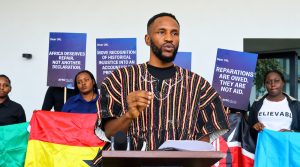
The AfroTalks Youth Assembly has formally presented a petition at the United Nations Headquarters in Nairobi, demanding enforceable reparatory justice for Africa and people of African descent over the historical injustices of slavery, colonialism and economic exploitation.
The petition, presented on Thursday, October 22, 2026, calls for concrete international action to address the enduring consequences of historical injustices, insisting that decades of recognition and diplomatic discussions must translate into measurable accountability, restitution and meaningful remedies.
The initiative marks a significant step in the Assembly’s campaign to place reparatory justice at the centre of international discussions on African sovereignty, economic independence and the continent’s future.
The presentation, however, was preceded by challenges, as security restrictions and interventions by authorities significantly limited participation in what was intended to be a peaceful gathering of African youth and advocates.
Despite the obstacles, representatives of the AfroTalks Youth Assembly proceeded with the initiative, ensuring that the petition reached the United Nations premises.
For the Assembly, the exercise represents more than the submission of a document. It signals a determination by a new generation of African advocates to push beyond symbolic acknowledgements of historical injustices towards concrete measures capable of addressing their lasting effects.
BEYOND ACKNOWLEDGEMENT TO ACCOUNTABILITY
The petition challenges the international community, particularly the United Nations, to bridge the gap between recognising historical injustices and establishing effective mechanisms to remedy their consequences.
It proposes a structured international framework for reparatory justice encompassing restitution, compensation, economic redress, institutional accountability and measures to address structural disadvantages inherited from centuries of exploitation.
The Assembly argues that reparatory justice should not remain an open-ended subject of international dialogue without clearly defined obligations, implementation timelines and accountability mechanisms.
It is calling for a process that translates discussions about historical wrongs into practical outcomes that can improve the circumstances of affected communities and future generations.
The campaign is expected to continue beyond the petition presentation, with the Assembly planning further diplomatic engagements, international advocacy, youth mobilisation and institutional follow-up to secure a substantive response.
It also intends to broaden the conversation across African countries, the diaspora, academic institutions, civil society organisations and relevant international bodies.
AFRICAN YOUTH ASSERTING OWNERSHIP OF THE CONTINENT
The initiative reflects the broader AfroTalks vision of empowering a generation of Africans to move beyond participating in conversations about the continent’s future to actively influencing the institutions, policies and decisions that shape it.
The petition also forms part of the discussions surrounding AfroTalks Nairobi 2026, which is being held under the theme, “Redefining African Sovereignty through Ownership, Capital and Innovation.”
The main conference is scheduled for Saturday, October 24, 2026, at Trademark Hotel in Nairobi.
By linking reparatory justice to African sovereignty and economic independence, the Assembly seeks to highlight how unresolved historical injustices continue to shape debates about development, ownership of resources and the continent’s ability to determine its own future.
The initiative positions reparatory justice as part of a broader conversation about Africa’s right to address the historical conditions that have contributed to its present-day economic and structural challenges.
Speaking on the need for accountability, AfroTalks Founder and Convenor Bright Tenbil said the international community had focused on recognising historical injustices without taking sufficient action to address them.
“It has been very obvious that, over the years, there has been no accountability. It is just a matter of recognition, acknowledgement and nothing else,” Tenbil said.
His remarks underscore the Assembly’s position that recognition alone cannot adequately address the enduring consequences of slavery, colonialism and exploitation without practical measures to deliver justice.
CAMPAIGN TO CONTINUE
The AfroTalks Youth Assembly says it will continue seeking formal engagement with relevant United Nations offices and pursuing acknowledgement and consideration of the petition.
It also plans to build partnerships with organisations and advocates working to advance reparatory justice, while mobilising support across Africa and the diaspora.
The Assembly has further highlighted the importance of protecting peaceful civic participation and legitimate advocacy within international institutional spaces.
The campaign will continue under the hashtag #UNEnforceReparatoryJusticeNow, as the group seeks to maintain pressure for a more structured and enforceable international response to historical injustices.
ABOUT AFROTALKS
AfroTalks is a Pan-African platform committed to amplifying African voices, advancing the African Dream and connecting emerging leaders, entrepreneurs, policymakers and changemakers across the continent.
Through conferences, youth advocacy, policy dialogue and cross-border collaboration, the platform promotes African integration, sovereignty, innovation and sustainable development.
The AfroTalks Youth Assembly brings together young African advocates committed to shaping the continent’s future through informed participation, institutional engagement and collective action.
Media Contact:
Brownson Adatsi
AfroTalks Communications and Public Relations
Email: info@afrotalks.com
Website: www.afrotalks.com
Petition: https://afrotalks.com/advocacy
Editorial note: Before publication, verify the official spelling of the founder’s name, as the supplied statement contains apparent transcription errors. Also, confirm the precise status of the petition’s receipt by the UN to distinguish formal submission to the institution from delivery to its premis