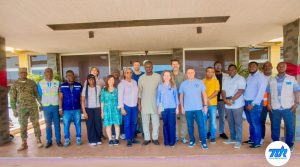
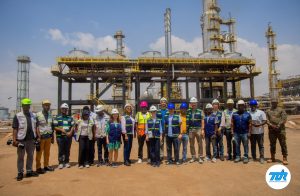
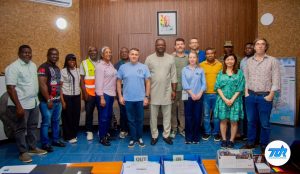
A delegation from the International Monetary Fund (IMF) has visited the Tema Oil Refinery (TOR) to familiarise itself with the refinery’s operations, assess ongoing rehabilitation works and gain insight into management’s efforts to restore the facility to sustained operational and financial stability.
The visit formed part of the IMF team’s engagements with relevant government authorities and selected state-owned enterprises in Ghana to understand their operations, financial positions, challenges and contributions to the national economy.
The IMF delegation was led by the Fund’s Ghana Resident Representative, Dr. Adrian Alter, while the TOR team was led by the Managing Director, Mr. Edmond Kombat, Esq.
During a meeting with the delegation, Mr. Kombat outlined the operational and financial challenges inherited by the current management, as well as measures introduced since May 2025 to restore confidence in the refinery’s operations and revive its major processing plants.
Addressing the delegation, the Managing Director emphasised that management had relied on internally generated funds to sustain the refinery’s operations since assuming office.
“Since this new management took over, we have not received a dime from government. Every single thing is done through our internally generated funds,” Mr. Kombat said.
He explained that management had prioritised financial discipline, operational improvements and the rehabilitation of critical facilities as part of efforts to reposition the refinery for long-term sustainability.
Mr. Kombat also disclosed that TOR was engaging the government over its outstanding debt obligations, with discussions focused on possible restructuring and the reconciliation of historical financial commitments between the refinery and the state.
According to him, TOR inherited a debt burden of approximately US$517 million, of which about US$120 million is owed to government.
“Out of the US$517 million debt we inherited, we owe about US$120 million. To government. We are trying to restructure our debt with government,” he explained.
The refinery is in talk with other state institution on some outstanding obligations between TOR and those institution. Management is exploring possible netting-off arrangements to establish the actual financial position of the respective parties.
On the refinery’s financial performance, Mr. Kombat disclosed that TOR recorded a profit in the previous year, expressing optimism that the company could maintain profitability in the current and subsequent years.
He attributed the positive outlook, in part, to improved macroeconomic stability and ongoing efforts to strengthen the refinery’s operational and financial position.
As part of its long-term strategy, management is considering a potential listing of TOR on the Ghana Stock Exchange to attract investment and provide additional capital for the refinery’s operations and expansion.
Mr. Kombat explained that a stock market listing could create opportunities for Ghanaian institutions and other investors to acquire shares in the company, thereby providing another avenue for raising funds to support its recovery and growth.
The IMF delegation also sought clarification on the volume of crude oil processed by TOR, particularly supplies sourced from Ghana’s domestic oil fields.
In response, Mr. Kombat indicated that the refinery had processed approximately five million barrels of crude oil, including about two million barrels sourced from Ghanaian fields, with the remainder coming from external sources.
He explained that TOR’s first domestic crude supply came from the Jubilee field through a transaction with Vitol, which was fully paid for. He also acknowledged the contribution of the Ghana National Petroleum Corporation (GNPC), which supplied its share of Ghana’s crude allocation to the refinery.
“Our first domestic crude came from the Jubilee field through Vitol, and it was fully paid for. GNPC also gave us its portion of Ghana’s allocation,”
Mr. Kombat stated.
He further noted that Ghana produces approximately 38 million barrels of crude oil annually, with about 11 million barrels representing the government’s share.
The Managing Director expressed hope that GNPC would make its full crude allocation available to TOR for refining by the following year, a development he said could improve feedstock availability and support more consistent refinery operations.
The delegation also sought to understand the impact of TOR’s resumption of operations on the Ghanaian economy and consumers.
In response, Mr. Kombat highlighted the refinery’s contribution to domestic petroleum product availability, price stability and the country’s ability to withstand disruptions in the international petroleum market.
He explained that domestic refining could help reduce Ghana’s exposure to external supply shocks, particularly during periods of geopolitical tension and uncertainty in global oil markets, including the ongoing conflict in the Middle East.
He also acknowledged government interventions aimed at cushioning consumers against the effects of changes in petroleum prices, noting the importance of maintaining reliable domestic supply.
Highlighting the refinery’s commercial potential, Mr. Kombat drew attention to TOR’s tank farm, storage infrastructure and product distribution network.
He indicated that TOR has approximately one million metric tonnes of storage capacity, which is three times the capacity of the Bulk Oil Storage and Transportation Company (BOST).
The Managing Director further explained that TOR is connected to eight privately operated depots, enabling the refinery to pump petroleum products directly to those facilities.
He said the arrangements provide additional revenue opportunities for the refinery, alongside other commercial activities, including laboratory services for petroleum product testing.
The discussions also covered corporate governance and financial accountability, particularly efforts to clear a six-year backlog of unaudited accounts.
Mr. Kombat explained that the Ghana Audit Service had undertaken the audit exercise to address the six 6) years outstanding backlog. He added that management intended to appoint an external audit firm at the refinery’s next Annual General Meeting (AGM) to undertake subsequent audits. KPMG had previously conducted audit assignments for the company.
The Managing Director also briefed the delegation on improvements in financial reporting and internal controls, staff-related reforms and measures to sustain crude supply for continued operations.
He noted that these initiatives were part of a broader management strategy to improve accountability, strengthen financial discipline and enhance operational efficiency.
The IMF team was further briefed on ongoing work to increase the refinery’s processing capacity, rehabilitate other critical units and restore facilities needed to support more reliable operations.These interventions are intended to strengthen TOR’s contribution to Ghana’s energy security, improve its financial sustainability and position it to play a more significant role in the country’s petroleum value chain.
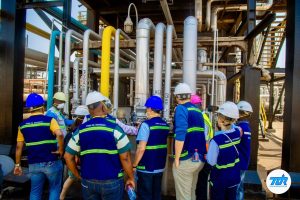
Following the discussions, the delegation toured parts of the refinery to observe some of the rehabilitated facilities and ongoing engineering works.
The tour provided the IMF team with an opportunity to gain first-hand insight into TOR’s operational environment, the progress made under the current management and the work that remains to be completed.
Members of the delegation expressed appreciation for the engagement and the opportunity to better understand the refinery’s operations and recovery efforts.
The visit provided a platform for TOR management to outline the measures being pursued to restore critical infrastructure, improve financial performance and strengthen the refinery’s contribution to Ghana’s energy security.
The Tema Oil Refinery (TOR) remains Ghana’s premier refinery, continuing to serve customers both domestically and beyond the country’s borders.