
The Inter-Governmental Action Group against Money Laundering in West Africa (GIABA) has called on investigative journalists across West Africa to strengthen their skills in tracing financial transactions and exposing economic and financial crimes.
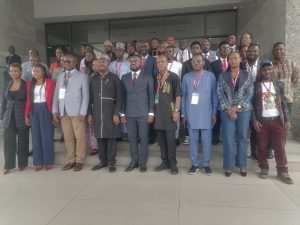
The call was made at the opening of a three-day Regional Training Workshop on Investigative Reporting of Economic and Financial Crimes, held in Accra from September 22 to 24, 2026.
The workshop brought together journalists and stakeholders from across the region to deepen their understanding of money laundering, terrorist financing, proliferation financing and other forms of economic and financial crime.
Director General of GIABA, Mam Cherno Jallow, said the media remained a strategic partner in the regional fight against financial crime, stressing that investigative journalism was critical to promoting transparency, accountability and good governance.
He said journalists played an important role in uncovering illegal practices, informing the public, challenging decision-makers and drawing attention to weaknesses that could be exploited by criminals.
According to him, West Africa continues to face evolving threats, including high-level corruption and illicit financial flows, particularly from the extractive sector, terrorism-related activities, drug trafficking, misuse of virtual assets and weak regulatory oversight of designated non-financial businesses and professions.
Mr Jallow said GIABA had, since 2009, deliberately engaged and trained journalists across ECOWAS member states as part of efforts to build a strong media partnership in combating money laundering and terrorist financing.
He noted that the organisation’s engagement with journalists had attracted international attention, with other regional bodies studying and adapting GIABA’s approach to media engagement.
He said GIABA’s 2023-2027 Strategic Plan, aligned with the ECOWAS Vision 2050, had supported progress in strengthening legal and institutional frameworks, capacity building, financial transparency and regional and international cooperation.
Among the achievements, he cited support for the establishment of Financial Intelligence Units in almost all ECOWAS member states, training for thousands of stakeholders and efforts to promote beneficial ownership disclosure to reduce opportunities for criminals to hide behind complex corporate structures.
Mr Jallow also disclosed that GIABA had completed the first and second rounds of mutual evaluations of its member states and had commenced preliminary work on the third round.
He said the training in Accra was intended to sharpen journalists’ investigative reporting skills, strengthen collaboration between GIABA and the media, expose participants to regional initiatives and modern investigative techniques, and consolidate a network of journalists committed to transparency.
The Director General, however, expressed concern about poor reporting, inadequate due diligence and misinformation in some media reports on anti-money laundering and counter-terrorist financing issues.
He urged participants to use the training to improve their knowledge, build professional networks and produce accurate, evidence-based report.
The Chief Executive Officer of Ghana’s Financial Intelligence Centre (FIC), Mr Albert Kwadwo Twum Boafo, in a welcome address, said the fight against economic and financial crime required cooperation among financial intelligence units, law enforcement agencies, regulators, prosecutors, the judiciary, private sector, civil society and the media.
He said the changing nature of financial crime, driven by technology, digital financial services, virtual assets, complex corporate structures and cross-border transactions, required journalists to acquire specialised investigative skills.
Mr Twum Boafo urged journalists to “follow the money” by examining financial records, identifying beneficial owners, analysing procurement information, connecting seemingly unrelated transactions and investigating who owns and moves assets.
He stressed that investigative journalism should go beyond obtaining information to include rigorous verification, proper context, protection of sources and respect for professional standards and due process.
He said financial intelligence could reveal patterns that individual transactions might not expose, noting that apparently unrelated transactions could, when analysed together, reveal wider networks of financial crime.
The FIC CEO encouraged journalists to look beyond individual transactions and investigate the people behind companies, ownership structures behind assets and financial trails behind suspected crimes.
He said the ultimate objective should not simply be to produce more stories about financial crime, but to produce well-informed, evidence-based and impactful journalism that helps the public understand how financial crime operates and its effects on communities and economies.
The workshop also underscored the importance of sustained collaboration between GIABA, national institutions and the media in strengthening public awareness and accountability across West Africa.
Mr Jallow concluded by describing journalists as among the most powerful “beacons” in the fight against money laundering and terrorist financing, urging them to help ensure that transparency prevails over secrecy and illicit financial activity.

