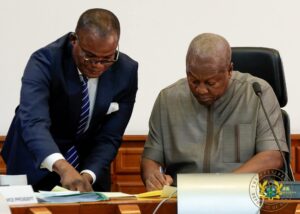
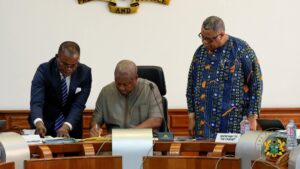
President John Dramani Mahama has formally assented to the 24-Hour Economy Authority Bill, 2025, setting the stage for the full-scale implementation of one of his administration’s flagship economic transformation policies.
The brief but symbolic signing ceremony took place on Thursday, February 19, 2026, ahead of the 13th Cabinet meeting. By appending his signature, the President gave legal backing to the establishment of the 24-Hour Economy Authority, the central institution tasked with coordinating and driving round-the-clock economic activity across the country.
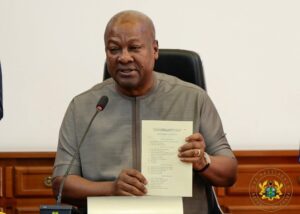
Speaking shortly after the signing, President Mahama described the legislation as a major milestone in government’s broader agenda to boost productivity, attract investment, and generate sustainable jobs—particularly for Ghana’s growing youth population.
“Cabinet colleagues, I have just appended my signature to give assent to the 24-Hour Authority Bill. This Bill, which Ghanaians have been waiting for, was one of our flagship strategies for economic transformation,” he stated.
The President acknowledged that the legislative process required careful consideration to ensure the policy was anchored on a strong legal and institutional framework. He noted that the focus must now shift decisively from planning to execution.
“We must move from strategy to implementation. The business sector is waiting, Ghanaian investors are waiting, foreign investors are waiting,” he stressed.
According to him, investors are particularly keen on the incentive framework that will accompany the policy. He explained that clearly defined tax incentives, regulatory reforms, and infrastructure support will be critical in encouraging businesses to expand operations beyond traditional working hours, thereby increasing productivity and employment.
The newly established 24-Hour Economy Authority will serve as the coordinating hub between the public and private sectors. It is expected to harmonise sector participation, facilitate industrial expansion, and help remove key infrastructure and regulatory bottlenecks that could hinder continuous economic activity.
Government officials indicate that the next phase will focus on rolling out detailed implementation guidelines, sector-specific frameworks, and incentive packages to operationalise the policy nationwide.
The assent signals a transition from policy promise to practical rollout, with the administration positioning the 24-hour economy as a cornerstone of its long-term strategy to modernise Ghana’s economic structure and enhance competitiveness in the global market.