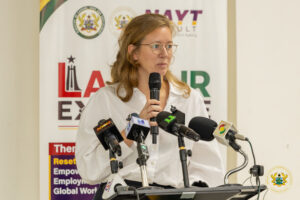
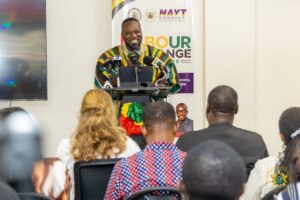
The Government of Ghana, through the Ministry of Youth Development and Empowerment and the Ministry of Labour, Jobs and Employment, has officially launched a Labour Exchange Programme aimed at creating structured, safe and legal employment pathways for Ghanaian youth in Germany and other parts of Europe.
The programme was launched on Wednesday, July 15, 2026, at the Conference Room of the Ministry of Labour, Jobs and Employment in Accra, under a Memorandum of Understanding (MoU) signed between the two ministries and NAYT Consult Limited, an organisation specialising in labour mobility and international recruitment solutions.
Read Also:
The initiative seeks to address youth unemployment while positioning Ghana as a reliable source of skilled and qualified talent for the global labour market.
Launching the programme, the Minister for Youth Development and Empowerment, Hon. George Opare Addo described the initiative as “another important milestone” in Ghana’s efforts to create sustainable employment opportunities for young people and a practical step towards “Resetting the Agenda for Youth Employment in Ghana.”
Ghana’s Youthful Population Presents Both Opportunity and Challenge
The Minister noted that Ghana’s greatest asset remains its youthful population, which constitutes 38.2 per cent of the country’s total population. However, he pointed out that the growing youth population continues to place increasing pressure on the labour market.
According to him, more than 100,000 graduates leave Ghana’s universities and technical and vocational institutions every year with the expectation of finding meaningful employment opportunities. Yet the creation of quality jobs has not kept pace with the growth of the labour force, leaving many young people unemployed or underemployed.
“Ghana is blessed with a youthful population full of talent, creativity, resilience and ambition,” the Minister said. “Our responsibility is to create an enabling environment that allows them to realise their full potential, whether within Ghana or beyond our borders.”
He stressed that young people should be viewed not merely as beneficiaries of government interventions but as strategic partners in national development whose talents can contribute significantly to economic growth both locally and internationally.
Creating Legal Pathways to International Employment
The Labour Exchange Programme is designed to provide a transparent and dignified avenue for qualified Ghanaian youth to access international employment opportunities, particularly within the European labour market.
The initiative will focus specifically on Germany during its initial phase, leveraging growing labour demands across key sectors of the German economy.
Under the programme, participants will benefit from:
Recruitment and screening processes.
German language training and certification.
Professional development and workplace readiness preparation.
Job matching with accredited employers.
Visa and work permit facilitation.
Travel support and deployment services.
Post-placement monitoring and welfare support.
The programme aims to ensure that young Ghanaians are fully prepared to thrive professionally and socially in their host countries.
Addressing Global Labour Shortages
The Minister highlighted that the initiative comes at a time when the international labour market is experiencing significant workforce shortages across several critical sectors.
These sectors include:
Healthcare
Manufacturing
Transportation and driving
Agriculture
Hospitality and tourism
Information technology
Logistics
Skilled trades and technical services
According to the Minister, Ghana possesses a growing pool of energetic and capable young people who can help fill these workforce gaps when provided with the appropriate training, support and preparation.
“This programme is not merely about facilitating overseas employment,” he stated. “It is about investing in human capital, strengthening the competitiveness of our workforce and enabling young Ghanaians to participate confidently in the global economy.”
Promoting Safe and Ethical Labour Migration
A key feature of the Labour Exchange Programme is its strong emphasis on legal, safe and ethical migration.
The Minister reiterated government’s commitment to protecting the rights, welfare and dignity of all participating Ghanaian workers.
He explained that the MoU establishes mechanisms that will ensure:
Transparency in recruitment processes.
Compliance with international labour standards.
Protection of workers’ rights.
Continuous support throughout the employment journey.
Monitoring of participants during their first two years abroad.
The programme seeks to eliminate risks associated with irregular migration by offering structured and regulated employment pathways that meet international best practices.
Collaborative Approach to Youth Employment
The Minister emphasized that government alone cannot solve the challenge of youth unemployment, calling for greater collaboration among public institutions, private sector actor, development partners and international employers.
He commended NAYT Consult Limited for its vision and technical leadership in facilitating international employment opportunities and building strategic partnerships with employers abroad. He also praised the Ministry of Labour, Jobs and Employment for ensuring that the programme aligns with national labour policies and international standards.
The partnership will be governed through a two-tier structure comprising a Steering Committee, which will provide strategic oversight, and a Technical Committee, responsible for recruitment, training, deployment and worker welfare monitoring.
Expected Impact on Ghana’s Economy
Beyond creating jobs, the Labour Exchange Programme is expected to deliver broader economic and developmental benefits.
The Minister stated that the initiative is expected to contribute to:
Reduction in youth unemployment.
Increased household incomes.
Enhanced skills transfer and knowledge exchange.
Growth in remittance inflows.
Stronger bilateral labour and economic relations between Ghana and Europe.
Greater participation of Ghanaian professionals in the international labour market.
He noted that young professionals who gain international work experience are likely to return home with valuable technical expertise, global networks and professional knowledge that can accelerate national development.
“This is the type of strategic investment in human capital that will help build a resilient and prosperous economy for future generations,” he remarked.
Building Ghana’s Global Workforce
Addressing prospective beneficiaries, the Minister encouraged young people to approach the opportunity with professionalism, discipline, integrity and adaptability.
He reminded participants that they would serve as ambassadors of Ghana and that their performance abroad would influence global perceptions of Ghanaian workers and create opportunities for future generations.
“As we officially launch the Labour Exchange Programme today, I reaffirm my Ministry’s unwavering commitment to its successful implementation,” he declared.
The Labour Exchange Programme represents a bold and innovative response to the challenge of youth unemployment. By combining government oversight with private-sector expertise, the initiative provides a sustainable pathway for Ghanaian youth to access global employment opportunities while contributing to national economic transformation.
As implementation begins, stakeholders believe the programme will strengthen Ghana’s position as a trusted source of skilled labour and advance the country’s vision of empowering young people, expanding economic opportunities, and ultimately building the Ghana we want.