
HomeBusinessGhana’s Marine Protected Area at Risk by Offshore Gold Exploitation

Ghana’s Marine Protected Area at Risk by Offshore Gold Exploitation

Date:

Related stories

Local Government Minister Commends DRIP Team for Progress at IRECOP Waste Evacuation Site

  The Minister for Local Government, Chieftaincy and Religious Affairs,...

Hon. Mahama Ayariga hands over 20 waste collection tricycles on behalf of the AMA

  The Minister for Local Government, Chieftaincy and Religious Affairs,...

Local Government Ministry directs assemblies to verify billboard permits nationwide

  The Ministry of Local Government, Chieftaincy and Religious Affairs...

Hon. Ayariga hands over Honda motorcycles to boost Aayalolo contra-flow ahead of Christmas

  Efforts to ease rush-hour congestion in Greater Accra have...

BEYOND EARLY DETECTION: WHAT HAPPENS AFTER A BREAST CANCER DIAGNOSIS? 

  Breast cancer awareness must go beyond pink ribbons, screening campaigns and calls for early detection. Ghana must also confront whether its health system is adequately prepared to care for those who receive a diagnosis. Every October, pink ribbons, awareness campaigns and screening activities remind us of the importance of early detection in the fight against breast cancer. Across workplaces, churches, communities and health facilities, women are encouraged to examine their breasts, attend screening programmes and seek medical attention when they notice unusual changes. These messages are important. Early detection can improve treatment outcomes and save lives. But after losing someone I cared deeply about to breast cancer, I have found myself reflecting on a question that deserves equal attention: What happens after early detection? Let me call her Abena. Abena was a woman in her late thirties, a working professional who had spent more than a decade advocating for breast cancer awareness. She organised screening activities within her church and workplace and encouraged other women to take their breast health seriously. She understood the importance of early detection and actively promoted it. In August 2023, she discovered a lump in her armpit. An initial ultrasound examination reportedly indicated that the finding was benign. However, the swelling persisted, and a month later she noticed changes in her left breast. Further investigations, including biopsy, eventually confirmed breast cancer in November 2023. What followed was a difficult journey through the healthcare system. The physician who requested the investigations had travelled outside the country by the time the results became available. Abena was asked to wait until the physician returned before a referral could be made to the next level of care. Eventually, a colleague facilitated the referral. At the oncology unit, she was informed that the workload was high and that an arrangement described to her as "intramural" payment could secure an earlier appointment. Without this payment, her first appointment would have been in February 2024. She paid and was seen that same day. Subsequent review visits also involved additional payments.   The financial demands did not end with securing appointments. Each chemotherapy session cost approximately GH¢2,000, while a supportive injection administered after each session cost about GH¢900 at the time. The medication was provided for administration by health workers at a nearby facility. Abena completed eight cycles of chemotherapy and was preparing for a total mastectomy. Throughout this period, her health deteriorated. She experienced significant complications, including loss of sight and speech, and eventually died in June 2024. Yet, even while battling the illness, she managed to complete her Master of Laws programme. Her determination to keep going remains one of the things I remember most about her. I share Abena's story not to suggest that every aspect of her care was inappropriate or that one experience represents the entire health system. Neither can I establish that the challenges she encountered alone determined the outcome of her illness. However, her experience raises difficult questions about access, affordability, referral coordination and the support available to patients navigating serious illnesses in Ghana. A diagnosis should mark the beginning of a coordinated response, not the beginning of another struggle to find care. BEYOND AWARENESS: EXAMINING THE HEALTH SYSTEM  Early detection is only one part of the cancer care pathway. Following a suspicious finding, patients need timely diagnostic investigations, clear communication of results, appropriate referral, specialist consultation, treatment and continuous follow-up. These services must work together. Delays at any point can create additional anxiety, financial pressure and uncertainty for patients. This is particularly important when viewed against Ghana's commitment to achieving Universal Health Coverage (UHC) by 2030. The Sustainable Development Goals, especially SDG 3, call on countries to ensure healthy lives and promote well-being for all ages. Target 3.8 specifically commits countries to universal health coverage, including access to quality essential healthcare services, affordable medicines and financial risk protection. These commitments must translate into meaningful experiences for people who seek care. Universal health coverage cannot be measured simply by the number of people who enter a health facility or the availability of screening services. It must also be reflected in whether patients receive the right diagnosis at the right time, whether referrals lead to actual access to care, whether treatment is affordable and whether continuity of care is assured. The question is not only whether we can detect diseases early, but whether our health system is prepared to respond effectively when we do. Patient navigation is one area that deserves greater attention in strengthening cancer care. Nurse navigators play an important role in helping patients move through what can be a complex and overwhelming healthcare pathway. They support coordination of appointments and referrals, facilitate communication between patients and healthcare providers, help identify financial and psychosocial barriers and promote continuity throughout treatment. Ghana has made efforts to introduce and strengthen patient navigation services. However, we must look beyond the existence of individual initiatives and ask questions about their reach and sustainability. How many breast cancer nurse navigators are available across the country? How many have undergone structured, competency-based training in patient navigation? Are these services accessible to patients outside the major tertiary hospitals? Do we have adequate systems for their deployment, supervision and continued professional development? A patient navigator should not merely direct a patient from one department to another. The role requires the knowledge and skills to coordinate care, anticipate barriers and help ensure that patients are not lost along the treatment pathway. Strengthening this service should therefore form part of our broader investment in cancer care. The challenges highlighted by Abena's experience are also not exclusive to cancer. Patients living with hypertension, diabetes, stroke, kidney disease and other chronic conditions face similar needs for timely diagnosis, appropriate referral, affordable medicines, regular monitoring and continuity of care. As the burden of non-communicable diseases continues to increase, the demands on our health system will become even greater. This is therefore a broader health-system concern. We need to examine how effectively our services are organised to support patients from the point of first contact through diagnosis, treatment, rehabilitation and follow-up. The ability to provide continuous, coordinated and person-centered care must become a central measure of the quality of our healthcare delivery. TURNING POLICY COMMITMENTS INTO PATIENT EXPERIENCES  Ghana's Free Primary Healthcare initiative presents an opportunity to strengthen access to essential services, improve early identification of health conditions and reduce barriers at the primary healthcare level. Similarly, the Ghana Medical Trust Fund offers an opportunity to address some of the financial challenges associated with serious and chronic illnesses. These are important interventions, but their impact will depend on how effectively they connect with the wider health system. Expanding access to primary healthcare must be accompanied by adequate diagnostic capacity, functional referral systems, specialist services, essential medicines and a health workforce equipped to provide quality care. Financial support must also translate into access to the actual services patients need and when they need them. We must be careful not to create a situation where patients are encouraged to seek early care but encounter delays, prohibitive costs or limited treatment options once a serious diagnosis is confirmed. Access to healthcare should not end at the point of screening or diagnosis. It must extend throughout the patient's journey. This also calls for deliberate investment in the health workforce. Nurses and midwives are central to patient education, early identification, care coordination, treatment support and follow-up. Their capacity must be strengthened through appropriate training, adequate staffing, supportive working environments and the resources required to deliver quality care. Patient navigation, for instance, should not depend solely on isolated projects or the commitment of a few individuals. It should be deliberately integrated into the organisation of cancer services. BEYOND OCTOBER: A CALL FOR NATIONAL REFLECTION  Breast cancer awareness should not end when October ends. Screening campaigns and public education remain essential, but they must be matched by a health system that can respond to the needs of those who receive a diagnosis. Abena's story is a reminder that behind every diagnosis is a mother, a family and a future that may depend on how effectively the health system responds. It is also a reminder that the success of our health policies should ultimately be judged by the experiences and outcomes of the people they are intended to serve. As a country working towards UHC by 2030, we must move beyond counting the number of people screened, educated or reached through awareness campaigns. We must also ask whether those who need further investigations can access them promptly, whether referrals are completed, whether treatment is affordable and whether patients receive the support required to complete their care. This reflection is in honour of Abena and the souls our health system might have failed. Their stories should challenge us to look beyond awareness and confront the gaps that patients encounter when they need care the most. Early detection is important. But what happens afterwards is equally important. And so, beyond the pink ribbons, the screening campaigns and the annual calls for early detection, I leave us with one question: WHAT'S NEXT AFTER EARLY DETECTION?  I hope this question will spark a much-needed national conversation among policymakers, healthcare professionals, health institutions, civil society, communities and every Ghanaian who depends on the health system. We must collectively examine whether our healthcare delivery system is adequately prepared not only to detect illnesses, but also to provide timely, affordable, quality and continuous care to those who need it. Maame Akosua Serwaa Gyening Email: masagg30@gmail.com  


By HELP Foundation Africa

Ghana took a historic step to protect its marine environment in April 2026, the country established its first Marine Protected Area (MPA) in the Greater Cape Three Points area of the Western Region. Covering approximately 703.86 square kilometres and involving 21 coastal communities, the MPA represents a national commitment to restore declining fish stocks, protect marine biodiversity, strengthen coastal livelihoods and secure the future of Ghana’s fisheries.

But barely has this important conservation commitment begun when another question is confronting Ghana: Could offshore gold exploration and potentially future seabed mining undermine the very marine ecosystem that the MPA was created to protect?
This is not an argument against responsible mineral exploration. It is an argument for responsible ocean governance.

The issue is whether Ghana can protect one part of the ocean while allowing activities that could damage the ecological processes on which that protected area depends.

Why did Ghana establish the Greater Cape Three Points MPA?
The answer is simple: Ghana’s marine ecosystem is under pressure, and fish stocks are declining. The Greater Cape Three Points area was selected because it is ecologically important. Scientific assessments have identified the waters around Cape Three Points as an area of nutrient-rich oceanic upwelling that supports high productivity of phytoplankton and zooplankton the foundation of the marine food chain.

This productivity supports important fish species, including sardinella, anchovies, carangids and scombrids, as well as marine mammals. The area also serves as a feeding, resting and spawning area for round sardinella, an important fish resource shared between Ghana and neighbouring countries.

The MPA was therefore not created simply because the area is beautiful. It was created because the area produces life. And that life supports Ghana’s fisheries.

The MPA is more than a conservation zone. It is tempting to think of an MPA as an area where fishing is simply restricted.

That is not the real objective.
The Greater Cape Three Points MPA is intended to protect and restore the ecological systems that make fishing possible.

Its management framework seeks to combine ecosystem protection, sustainable fisheries, research and monitoring, enforcement, stakeholder participation and sustainable livelihoods.

The underlying logic is powerful: Protect important habitats → allow fish to reproduce and grow → rebuild fish populations → increase fish availability → strengthen livelihoods and food security.

In this sense, the MPA is effectively a natural fish bank for Ghana.

If managed properly, it can help rebuild fish populations that have been depleted by overfishing and other pressures.

The hidden infrastructure beneath Ghana’s fisheries. The most important assets protected by the MPA are not always visible from the surface.
Beneath the waves are:
spawning grounds;
nursery habitats;
seabed communities;
plankton-producing ecosystems;
feeding grounds;
sediment systems;
nutrient cycles;
and interconnected food webs.
Scientific research conducted with communities in the Greater Cape Three Points area found that fish nursery grounds were among the most highly valued ecosystem services because shallow coastal habitats provide food, protection and habitat for juvenile fish that eventually become adults available to fisheries.

This means that the real foundation of the MPA is habitat. If the habitat fails, the MPA’s ability to rebuild fish stocks also fails.

And this is where offshore gold becomes a serious concern.

Offshore gold: why should Ghana be concerned?
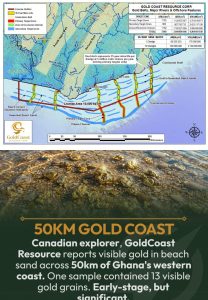
Recent reports indicate that ten offshore gold reconnaissance licenses have been granted covering approximately 10,000 square kilometres of Ghana’s western offshore area, extending for roughly 300 kilometres from Half Assini toward Winneba.

It is important to be precise that a reconnaissance license is not a mining lease, and reconnaissance should not automatically be described as commercial gold mining.

However, reported exploration plans include geophysical, bathymetric and seismic surveys, coring and sediment sampling. Concerns have also been raised about possible future progression toward prospecting, bulk sampling and shallow-water dredging.

That progression is what Ghana must examine very carefully.
Because the environmental question changes dramatically when exploration moves from looking for gold to physically disturbing the seabed to obtain it.

The greatest threat: destroying the habitat that produces the fish
The MPA is designed to protect fish habitat.
Seabed mining or dredging, by its nature, involves disturbing or removing seabed material.
This creates a fundamental contradiction that Ghana cannot ignore.
If the ecological productivity of the Cape Three Points marine system depends on healthy seabed, nursery and feeding habitats, what happens when those habitats are physically disturbed?

Potential impacts include:

1. Destruction of seabed habitat: The seabed is not simply sand or mud. It supports communities of organisms that form part of the marine food web. Removing or heavily disturbing seabed material can destroy these organisms and change the physical character of the habitat.bThe result may be a seabed that no longer performs the same ecological functions.

2. Sediment plumes and increased turbidity: Dredging and other intensive seabed disturbance can put large quantities of sediment into the water column. In shallow coastal waters, this can be particularly important. Increased suspended sediment can reduce water clarity, interfere with feeding, affect organisms living on the seabed and deposit material on surrounding habitats. The ecological footprint can therefore extend beyond the exact point where equipment is operating.

3. Damage to nursery grounds; This is perhaps the greatest concern for Ghana’s artisanal fisheries. Young fish require suitable nursery habitats. If those habitats are disturbed, buried, contaminated or otherwise degraded, fewer juvenile fish may successfully survive to adulthood. That can eventually translate into: less recruitment → fewer adult fish → lower catches → lower incomes. The scientific work undertaken in the Greater Cape Three Points area specifically identified nursery ecosystems as critical to continued fish production.

4. Disruption of spawning and feeding areas:b Cape Three Points is recognised as an important spawning, resting and feeding area for round sardinella and other marine species. Any activity that significantly alters these ecological conditions therefore deserves careful scrutiny.

The question is not merely: “Will the dredger kill fish?” The more important question is: “Will the activity reduce the ecosystem’s ability to produce fish?”
That is a much bigger question. What happens to the artisanal fisher?
Imagine a fisherman in Axim, Half Assini, Akwidaa, Cape Three Points, Dixcove or another coastal community.
He does not own the fish. He does not own the seabed. His livelihood depends on an ecosystem that he did not create.
If seabed disturbance reduces fish abundance, he may have to travel farther.
That means: more fuel → longer fishing trips → higher costs → greater risk → lower profit.

For women who process and trade fish, declining landings mean less fish to process and sell.

For families, it can mean lower income and greater food insecurity.
The impact therefore travels from the seabed into the household. This is why the MPA’s management framework appropriately recognises coastal communities and sustainable livelihoods as integral to conservation.

What should Government do?

HELP Foundation Africa believes Ghana should take the following steps before allowing offshore gold activities to progress into intrusive seabed operations:

1. Publish the exact license coordinates: Ghanaians have a right to know where these licenses are located.

2. Publish the approved work programmes: The public must know exactly what activities are authorised.

3. Conduct a spatial overlay: Government should publish one transparent map showing: gold licenses + 12-nautical-mile IEZ + Greater Cape Three Points MPA + fishing grounds + spawning areas + nursery areas + sensitive habitats.

4. Conduct an independent cumulative-impact assessment: The assessment should consider fisheries, biodiversity, sediments, water quality, coastal livelihoods and the MPA, not merely the immediate footprint of exploration.

5. Establish a clear “no-go” principle for sensitive habitats: Critical spawning, nursery and biodiversity areas should not be sacrificed for mineral extraction.

6. Do not allow automatic progression from reconnaissance to mining: Every transition to a higher-impact phase should require independent environmental and fisheries evidence.

7. Put fishing communities at the centre of the decision: Fishers, processors, traders, traditional authorities and coastal communities must have meaningful participation not merely be informed after decisions have already been made.

HELP Foundation Africa calls for transparency, independent scientific assessment, meaningful community participation and the application of the precautionary principle before any offshore gold programme progresses to activities capable of substantial seabed disturbance.

Kyei Kwadwo Yamoah
Tel: +233 244 81 7020 / Email: kkyeiyams@gmail.com
Executive Director
Human, Environment and Livelihood Platform Foundation (HELP Foundation Africa)

Latest stories