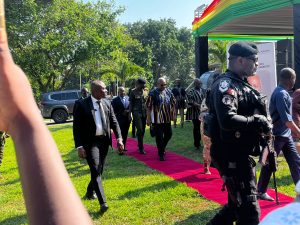
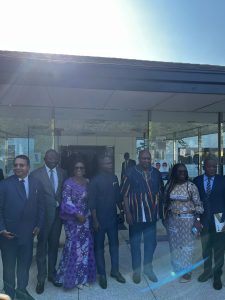
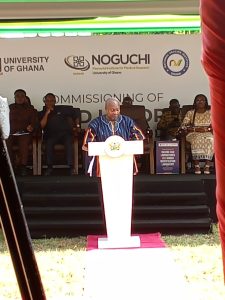
President John Dramani Mahama has commissioned a state-of-the-art Human Identification Laboratory (DNA Laboratory) and dedicated vaccine research and development facilities at the Noguchi Memorial Institute for Medical Research (NMIMR), marking a major milestone in Ghana’s efforts to strengthen health security, scientific research and vaccine self-sufficiency.
The two facilities are expected to enhance Ghana’s capacity to conduct DNA testing locally, support forensic investigations, identify victims of disasters and missing persons, and advance the development of vaccines to address existing and emerging infectious diseases.
Speaking at the commissioning ceremony, President Mahama described the facilities as significant investments in Ghana’s determination to safeguard public health, promote scientific innovation and reduce dependence on foreign institutions for critical medical research and services.
He said the establishment of the DNA laboratory had become urgent following the August 6, 2025 helicopter crash at Adansi Akrofuom, which claimed the lives of eight Ghanaians.
The President recalled that tissue samples recovered from the crash site had to be transported to South Africa for DNA analysis, leaving bereaved families waiting anxiously for several days before the identities of their loved ones could be established.
He described Ghana’s inability to conduct the tests locally as a day of shame for the country, adding that the newly commissioned facility would ensure that such dependence became a thing of the past.
“That will be a thing of the past. And so I’m proud now that we have a world-class facility that will strengthen our forensic and public health systems,” he stated.
President Mahama said the laboratory would provide timely answers to families during national tragedies and enable them to give their deceased relatives decent burials without unnecessary delays.
He, however, stressed the importance of effective communication between the laboratory and agencies responsible for identifying victims to ensure that affected families received accurate information promptly.
Beyond disaster victim identification, the President said the facility would support police investigations involving rape, murder and other criminal offences where DNA evidence could help establish the facts and secure justice.
He added that the laboratory would also provide services for paternity and maternity disputes, inheritance cases and other matters requiring scientific confirmation of biological relationships.
On vaccine development, President Mahama said the new mRNA and protein research laboratories represented another important step towards building Ghana’s capacity to develop vaccines locally and strengthen the country’s health sovereignty.
He said the COVID-19 pandemic had exposed weaknesses in global vaccine supply chains, particularly the disadvantage faced by African countries when demand for vaccines increased worldwide.
According to him, developed countries prioritised their domestic needs, leaving African nations at the back of the queue during the pandemic.
The President noted that Ghana and other African countries must therefore invest in local scientific expertise, research infrastructure and pharmaceutical manufacturing to avoid similar challenges during future health emergencies.
He identified Mpox, Lassa fever, Ebola and Marburg virus disease among the infectious disease threats confronting the sub-region and the African continent, stressing that countries must build their preparedness between outbreaks rather than wait for emergencies.
President Mahama said the new laboratories would provide Ghanaian scientists with the necessary environment to conduct research, test new ideas and collaborate with international institutions towards developing vaccine candidates.
He disclosed that Ghana was among only five African countries using innovative mRNA technology to research and develop new vaccines.
He also commended the National Vaccine Institute (NVI) for establishing partnerships with the International Vaccine Institute and other institutions in Europe and the United States to strengthen the country’s scientific capacity.
The President further revealed that the NVI was discussing a possible partnership with a European institution on cancer vaccine research using mRNA technology.
He congratulated five Ghanaian scientists who had received specialised training in Brussels and Accra to operate the mRNA laboratory and train other researchers.
They are Prof. Linda Eva Amon, Prof. Peter Kodjoe-Pachin, Prof. Augustina Angela Silvaken, Dr. Rubin Jani Ayubo and Dr. Festus Kodjoe-Akwa.
President Mahama urged universities and research institutions to strengthen mentorship opportunities and collaboration among scientists, particularly young researchers, to build a sustainable pool of local expertise.
He also appealed to Ghanaians not to be apprehensive about participating in clinical trials, explaining that such trials were an essential part of vaccine development and scientific research.
He recalled how misinformation and public resistance had undermined efforts by Ghanaian researchers to conduct Ebola vaccine clinical trials during an earlier outbreak, resulting in the trials being moved to another African country.
He said Ghana could not develop its own vaccines without the willingness of citizens to participate in properly conducted clinical trials.
On the broader pharmaceutical industry, President Mahama reiterated government’s commitment to positioning Ghana as a pharmaceutical and biomanufacturing hub for West Africa and the wider continent.
He disclosed that government had backed the initiative with a US$1 billion allocation to the pharmaceutical sector under the New Economies Seventh Bill, with plans to establish pharmaceutical and biomanufacturing hubs in the Eastern, Central and Border regions.
The President described the current period as a golden era for Ghana’s vaccine and pharmaceutical industry, adding that the country must take advantage of its growing scientific capacity to improve healthcare delivery and drive economic transformation.
He further disclosed that government would spend US$46 million this year on vaccines required for child immunisation, particularly as Ghana prepares for its transition from Gavi financing by January 2030.
President Mahama expressed appreciation to the Ministry of Health, the National Vaccine Institute, the University of Ghana, Noguchi Memorial Institute for Medical Research, Africa CDC and other development partners for their contributions towards the establishment of the facilities.
The Minister of Health, Kwabena Mintah Akandoh, said the establishment of the Human Identification Laboratory was a direct response to President Mahama’s directive to develop local capacity for DNA testing following the August 6, 2025 helicopter crash.
He recalled that the identification of the eight victims had to be undertaken in South Africa because Ghana lacked the necessary equipment, despite having qualified scientific personnel.
He said the President subsequently directed the Ministry of Health to ensure that the country acquired the required technology to undertake such critical investigations locally.
Mr. Akandoh said the facility would help families obtain answers more quickly following disasters, assist in identifying missing persons and strengthen the work of the police and the courts.
He also announced that the government was working with relevant partners to secure accreditation for the laboratory to guarantee internationally recognised standards.
On vaccine development, the Minister said the COVID-19 pandemic had demonstrated the need for African countries to develop their own vaccines instead of relying heavily on external supplies.
He disclosed that the first vaccines bottled in Ghana were expected to be available on the market in 2027, describing the new research laboratories as an important foundation for advancing local vaccine development.
He thanked Ghana’s Indonesian partners, the University of Ghana, the Noguchi research team, Mahama Cares, ABB Medical Limited and other stakeholders for supporting the projects.
The Minister assured that the government would invest in human resources, equipment maintenance and the supply of essential materials to ensure the facilities operated effectively and delivered their intended benefits.
He also paid tribute to the eight Ghanaians who lost their lives in the August 6 helicopter crash, saying the establishment of the DNA laboratory would form part of their lasting legacy.