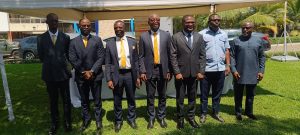
The Chief Executive Officer of the Minerals Commission, Mr Isaac Tandoh, has called for a stronger financial support system for indigenous Ghanaian businesses to enable them to compete effectively and capture a greater share of the country’s mining wealth.
He said although Ghana continued to record significant gold production and generate substantial export earnings from the mining sector, much of the economic value was not being retained within the country because local businesses lacked access to affordable financing to participate meaningfully in the industry.
Mr Tandoh made the remarks at a signing ceremony between the Minerals Commission and CalBank for a $100 million financing facility to support eligible Ghanaian businesses operating across the mining value chain.
The ceremony, held at the head office of the Minerals Commission in Accra, marked what he described as an important step towards translating Ghana’s local content policy into tangible economic benefits for indigenous businesses.
According to him, when the new management of the Minerals Commission assessed the mining sector, it became evident that despite the country’s considerable mineral production, the benefits were not sufficiently translating into wealth creation, business growth and improved livelihoods for Ghanaians.
He explained that the challenge was not necessarily the absence of local content regulations but the failure to translate those provisions into practical opportunities capable of transforming the lives of citizens.
Mr Tandoh said one of the major obstacles confronting indigenous mining companies was the high cost of borrowing, which placed them at a competitive disadvantage against foreign companies with access to cheaper financing in their home countries.
He recalled that while Australian, Canadian and American mining companies could secure financing at interest rates of between four and five per cent, their Ghanaian counterparts often had to contend with interest rates of between 30 and 35 per cent on cedi facilities and about 15 per cent on dollar-denominated loans.
He said the disparity made it difficult for Ghanaian businesses to compete for contracts and retain value within the domestic economy.
“All the value was going away just because our people were not getting the financing,” he observed.
Mr Tandoh consequently commended CalBank for responding to the Commission’s call by committing $100 million to finance eligible Ghanaian businesses in the mining industry.
He described the arrangement as unprecedented and expressed optimism that it would open a new chapter in efforts to strengthen indigenous participation in the mining sector.
He further disclosed that foreign mining companies routinely used their mining leases as collateral to secure financing for their operations, questioning why Ghanaian financial institutions could not provide similar support to local businesses.
Mr Tandoh cited a recent financing arrangement involving a loan from international commodity trading company Trafigura, which required the Commission’s involvement, as an example of how financing opportunities and associated financial benefits could go outside Ghana.
He argued that with CalBank now making substantial financing available locally, Ghanaian businesses should be able to access the necessary capital without relying excessively on foreign financial institutions.
The Minerals Commission CEO said the initiative was also consistent with President John Dramani Mahama’s emphasis on strengthening local content and ensuring that Ghanaians assumed greater responsibility for the country’s natural resource wealth.
Using an analogy of a bus, Mr Tandoh said indigenous participation in the mining industry had gradually moved from the back seat to the middle and subsequently to the front.
He, however, stressed that reaching the stage where Ghanaians could drive the sector required adequate financial resources.
We believe we can drive the bus, but you can’t drive the bus without fuel. CalBank is here to provide the fuel for us,” he said.
He expressed confidence that the partnership would help create a stronger indigenous mining industry and provide opportunities for Ghanaian businesses to grow into major national and international players.
CalBank commits $100 million
For his part, the Managing Director of CalBank, Mr Carl Selasi Asem, said the bank’s financing commitment was aimed at addressing one of the most significant challenges limiting the participation of indigenous companies in Ghana’s mining industry.
He said the importance of mining to Ghana’s economy could not be overstated, describing the sector as a strategic pillar of macroeconomic stability and a major source of foreign exchange, government revenue and employment.
Mr Asem noted that gold alone accounted for approximately 63 per cent of Ghana’s merchandise exports in 2025, generating export earnings in excess of $20 billion.
He said these figures underscored the need to ensure that the economic benefits of mining translated more meaningfully into opportunities for Ghanaian businesses.
According to him, indigenous contractors, small-scale miners, suppliers and service providers required not only technical expertise and business opportunities but also access to appropriate financing to compete effectively across the mining value chain.
He observed that many local businesses possessed the technical capabilities and commercial opportunities to undertake larger assignments but were constrained by inadequate financing to meet operational requirements, expand their activities and build the capacity needed to compete at scale.
“This is the gap that CalBank has identified, and we are here today to make a commitment to close that gap,” he stated.
Mr Asem explained that the facility would support working capital requirements, contract financing, invoice discounting, equipment acquisition and other strategic financing needs of eligible businesses operating within the mining sector.
He said the partnership brought together the regulatory oversight and industry expertise of the Minerals Commission and CalBank’s financial capacity to assess, structure and provide appropriate financing solutions.
The Minerals Commission would assist in identifying eligible businesses, while CalBank would undertake the necessary financial assessments and structure facilities to meet their requirements.
He encouraged mining contractors, suppliers, small-scale miners, service providers and licensed mining operators to engage with the bank and present their contracts, purchase orders, supply arrangements and investment proposals for consideration.
Mr Asem said the ultimate objective was to develop a stronger indigenous mining supply chain, equip Ghanaian businesses to undertake larger contracts and enable them to capture a greater share of the value generated by the industry.
He expressed confidence that the partnership would expand over time and contribute to building stronger Ghanaian businesses capable of sustaining economic growth.