
HomeEducationCutting the Fast-Acting Climate Pollutants: Ghana–UK Team Begins New Soil Research at CSIR-CRI Fumesua  

Cutting the Fast-Acting Climate Pollutants: Ghana–UK Team Begins New Soil Research at CSIR-CRI Fumesua  

Date:

Related stories

Local Government Minister Commends DRIP Team for Progress at IRECOP Waste Evacuation Site

  The Minister for Local Government, Chieftaincy and Religious Affairs,...

Hon. Mahama Ayariga hands over 20 waste collection tricycles on behalf of the AMA

  The Minister for Local Government, Chieftaincy and Religious Affairs,...

Local Government Ministry directs assemblies to verify billboard permits nationwide

  The Ministry of Local Government, Chieftaincy and Religious Affairs...

Hon. Ayariga hands over Honda motorcycles to boost Aayalolo contra-flow ahead of Christmas

  Efforts to ease rush-hour congestion in Greater Accra have...

BEYOND EARLY DETECTION: WHAT HAPPENS AFTER A BREAST CANCER DIAGNOSIS? 

  Breast cancer awareness must go beyond pink ribbons, screening campaigns and calls for early detection. Ghana must also confront whether its health system is adequately prepared to care for those who receive a diagnosis. Every October, pink ribbons, awareness campaigns and screening activities remind us of the importance of early detection in the fight against breast cancer. Across workplaces, churches, communities and health facilities, women are encouraged to examine their breasts, attend screening programmes and seek medical attention when they notice unusual changes. These messages are important. Early detection can improve treatment outcomes and save lives. But after losing someone I cared deeply about to breast cancer, I have found myself reflecting on a question that deserves equal attention: What happens after early detection? Let me call her Abena. Abena was a woman in her late thirties, a working professional who had spent more than a decade advocating for breast cancer awareness. She organised screening activities within her church and workplace and encouraged other women to take their breast health seriously. She understood the importance of early detection and actively promoted it. In August 2023, she discovered a lump in her armpit. An initial ultrasound examination reportedly indicated that the finding was benign. However, the swelling persisted, and a month later she noticed changes in her left breast. Further investigations, including biopsy, eventually confirmed breast cancer in November 2023. What followed was a difficult journey through the healthcare system. The physician who requested the investigations had travelled outside the country by the time the results became available. Abena was asked to wait until the physician returned before a referral could be made to the next level of care. Eventually, a colleague facilitated the referral. At the oncology unit, she was informed that the workload was high and that an arrangement described to her as "intramural" payment could secure an earlier appointment. Without this payment, her first appointment would have been in February 2024. She paid and was seen that same day. Subsequent review visits also involved additional payments.   The financial demands did not end with securing appointments. Each chemotherapy session cost approximately GH¢2,000, while a supportive injection administered after each session cost about GH¢900 at the time. The medication was provided for administration by health workers at a nearby facility. Abena completed eight cycles of chemotherapy and was preparing for a total mastectomy. Throughout this period, her health deteriorated. She experienced significant complications, including loss of sight and speech, and eventually died in June 2024. Yet, even while battling the illness, she managed to complete her Master of Laws programme. Her determination to keep going remains one of the things I remember most about her. I share Abena's story not to suggest that every aspect of her care was inappropriate or that one experience represents the entire health system. Neither can I establish that the challenges she encountered alone determined the outcome of her illness. However, her experience raises difficult questions about access, affordability, referral coordination and the support available to patients navigating serious illnesses in Ghana. A diagnosis should mark the beginning of a coordinated response, not the beginning of another struggle to find care. BEYOND AWARENESS: EXAMINING THE HEALTH SYSTEM  Early detection is only one part of the cancer care pathway. Following a suspicious finding, patients need timely diagnostic investigations, clear communication of results, appropriate referral, specialist consultation, treatment and continuous follow-up. These services must work together. Delays at any point can create additional anxiety, financial pressure and uncertainty for patients. This is particularly important when viewed against Ghana's commitment to achieving Universal Health Coverage (UHC) by 2030. The Sustainable Development Goals, especially SDG 3, call on countries to ensure healthy lives and promote well-being for all ages. Target 3.8 specifically commits countries to universal health coverage, including access to quality essential healthcare services, affordable medicines and financial risk protection. These commitments must translate into meaningful experiences for people who seek care. Universal health coverage cannot be measured simply by the number of people who enter a health facility or the availability of screening services. It must also be reflected in whether patients receive the right diagnosis at the right time, whether referrals lead to actual access to care, whether treatment is affordable and whether continuity of care is assured. The question is not only whether we can detect diseases early, but whether our health system is prepared to respond effectively when we do. Patient navigation is one area that deserves greater attention in strengthening cancer care. Nurse navigators play an important role in helping patients move through what can be a complex and overwhelming healthcare pathway. They support coordination of appointments and referrals, facilitate communication between patients and healthcare providers, help identify financial and psychosocial barriers and promote continuity throughout treatment. Ghana has made efforts to introduce and strengthen patient navigation services. However, we must look beyond the existence of individual initiatives and ask questions about their reach and sustainability. How many breast cancer nurse navigators are available across the country? How many have undergone structured, competency-based training in patient navigation? Are these services accessible to patients outside the major tertiary hospitals? Do we have adequate systems for their deployment, supervision and continued professional development? A patient navigator should not merely direct a patient from one department to another. The role requires the knowledge and skills to coordinate care, anticipate barriers and help ensure that patients are not lost along the treatment pathway. Strengthening this service should therefore form part of our broader investment in cancer care. The challenges highlighted by Abena's experience are also not exclusive to cancer. Patients living with hypertension, diabetes, stroke, kidney disease and other chronic conditions face similar needs for timely diagnosis, appropriate referral, affordable medicines, regular monitoring and continuity of care. As the burden of non-communicable diseases continues to increase, the demands on our health system will become even greater. This is therefore a broader health-system concern. We need to examine how effectively our services are organised to support patients from the point of first contact through diagnosis, treatment, rehabilitation and follow-up. The ability to provide continuous, coordinated and person-centered care must become a central measure of the quality of our healthcare delivery. TURNING POLICY COMMITMENTS INTO PATIENT EXPERIENCES  Ghana's Free Primary Healthcare initiative presents an opportunity to strengthen access to essential services, improve early identification of health conditions and reduce barriers at the primary healthcare level. Similarly, the Ghana Medical Trust Fund offers an opportunity to address some of the financial challenges associated with serious and chronic illnesses. These are important interventions, but their impact will depend on how effectively they connect with the wider health system. Expanding access to primary healthcare must be accompanied by adequate diagnostic capacity, functional referral systems, specialist services, essential medicines and a health workforce equipped to provide quality care. Financial support must also translate into access to the actual services patients need and when they need them. We must be careful not to create a situation where patients are encouraged to seek early care but encounter delays, prohibitive costs or limited treatment options once a serious diagnosis is confirmed. Access to healthcare should not end at the point of screening or diagnosis. It must extend throughout the patient's journey. This also calls for deliberate investment in the health workforce. Nurses and midwives are central to patient education, early identification, care coordination, treatment support and follow-up. Their capacity must be strengthened through appropriate training, adequate staffing, supportive working environments and the resources required to deliver quality care. Patient navigation, for instance, should not depend solely on isolated projects or the commitment of a few individuals. It should be deliberately integrated into the organisation of cancer services. BEYOND OCTOBER: A CALL FOR NATIONAL REFLECTION  Breast cancer awareness should not end when October ends. Screening campaigns and public education remain essential, but they must be matched by a health system that can respond to the needs of those who receive a diagnosis. Abena's story is a reminder that behind every diagnosis is a mother, a family and a future that may depend on how effectively the health system responds. It is also a reminder that the success of our health policies should ultimately be judged by the experiences and outcomes of the people they are intended to serve. As a country working towards UHC by 2030, we must move beyond counting the number of people screened, educated or reached through awareness campaigns. We must also ask whether those who need further investigations can access them promptly, whether referrals are completed, whether treatment is affordable and whether patients receive the support required to complete their care. This reflection is in honour of Abena and the souls our health system might have failed. Their stories should challenge us to look beyond awareness and confront the gaps that patients encounter when they need care the most. Early detection is important. But what happens afterwards is equally important. And so, beyond the pink ribbons, the screening campaigns and the annual calls for early detection, I leave us with one question: WHAT'S NEXT AFTER EARLY DETECTION?  I hope this question will spark a much-needed national conversation among policymakers, healthcare professionals, health institutions, civil society, communities and every Ghanaian who depends on the health system. We must collectively examine whether our healthcare delivery system is adequately prepared not only to detect illnesses, but also to provide timely, affordable, quality and continuous care to those who need it. Maame Akosua Serwaa Gyening Email: masagg30@gmail.com  


Fumesua, Kumasi – Ghana, September, 2026 (CSIR-CRI)) – Scientists from Ghana and the United Kingdom gathered at the CSIR-Crops Research Institute (CSIR-CRI) for the start of Geophysics for Climate-Smart Agriculture in Africa, a two-year research project hosted at the institute’s Multicultural Technology Park.

The project is funded by UK Research and Innovation through the Science and Technology Facilities Council, and runs from April 2026 to March 2028. It is led by the British Geological Survey, working with CSIR-CRI, the Kwame Nkrumah University of Science and Technology (KNUST), the Alliance of Bioversity International and CIAT, and the University of Nottingham.

Burning crop residues releases pollutants that warm the climate quickly and harm the air people breathe. A new research partnership at Fumesua is testing what happens when farmers leave that material on the soil instead — using technology borrowed from geology to see underground. 

A park built to tackle the fast movers 

The new project joins a platform created for exactly this purpose. The Multicultural Technology Park (MTP) at Fumesua was established by the ACE4ES Consortium, with support from the Climate and Clean Air Coalition, to advance sustainable agricultural innovation within an agroecology framework and to reduce greenhouse gas emissions and pollutants from farming.

Two of its targets — methane and black carbon — belong to a group known as short-lived climate pollutants. They do not linger in the atmosphere for centuries as carbon dioxide does. Methane largely disappears within about a decade; black carbon, the soot released by incomplete burning, falls out within days or weeks. But while they are up there, they are powerful, and black carbon settles on surfaces, darkening them and causing further warming.

That short life is the opportunity. Cutting these pollutants slows warming within years rather than generations, and because they also damage lungs and crops, the health and food-security benefits arrive immediately and locally. The park also targets nitrous oxide, which is long-lived, exceptionally potent, and largely emitted from soils and fertilizer.

Within the park, the residue management program pursues two connected goals: better soil health and an end to burning crop residues in the field. Burning is quick and cheap for the farmer, and it is also one of agriculture’s most direct sources of black carbon. Leaving residues on the ground is widely recommended instead. Proving what it does, and what it costs the farmer, is harder.


The farmer’s dilemma 

Dr. Eric Owusu Danquah, Principal Research Scientist at CSIR-CRI, set out the problem at the meeting. Residues are not spare material lying idle. The same maize stalks that would protect and feed the soil are also dry-season fodder that keeps a family’s goats and sheep alive. A farmer with two acres cannot easily forgo feed today while waiting several seasons for soil benefits to accumulate.

What the extension system needs, he argued, is evidence that measures the trade-off honestly, rather than advice that assumes one side of it.

Seeing underground 

The difficulty is that the most important effects happen where nobody can see them. Does mulch really hold water in the soil for longer? How deep does rainfall reach before it evaporates? And do the wetter patches also become places where soil microbes quietly release nitrous oxide — trading one climate problem for another?

Answering those questions has traditionally meant digging, which destroys the thing being measured and yields only a few scattered readings.

The project’s approach avoids digging altogether. A small, harmless electrical current is passed through the soil between buried sensors. Wet soil carries the current easily; dry soil resists it. Repeated over and over, the measurement builds something close to a moving picture of water in the ground: where it goes after rain, how long it stays, and how a mulched plot differs from a bare one.

The instruments will be built in Ghana. KNUST is assembling them from an open-source, low-cost design, and they will remain at the CSIR-CRI-hosted MTP at Fumesua under Ghanaian ownership when the project ends, operated by staff trained to maintain and repair them.


What is being tested 

The field experiment compares maize grown with three legume partners — cowpea, groundnut, and mucuna — across three levels of residue retention: none, half, and all. Each combination is repeated across three parts of the field so that treatment effects can be separated from differences in the land itself.
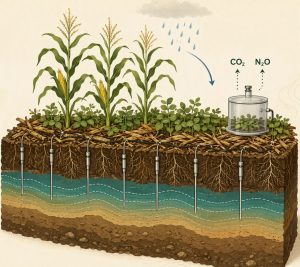
Alongside the soil-water imaging, chambers placed on the ground will capture the gases emitted from it. Measurements of methane and carbon dioxide begin this season. Nitrous oxide, which requires a more sensitive instrument arriving later, follows in the second season — allowing the team to first establish which conditions produce emissions, then test whether that understanding genuinely predicts them.

Much of the second day was spent, at the insistence of Professor Murray Lark of the University of Nottingham, writing down clear predictions before choosing what to measure. Groups drafted statements specific enough to be proved wrong, then worked out what evidence would settle each one.

Building people, not only data 

The grant behind the project is aimed at training the next generation of physicists, and the meeting reflected that. Sixteen early-career researchers from the partner institutions were assigned to working groups carrying real responsibilities in planning, data management and publication. Training includes hands-on fieldwork at Fumesua, a residential workshop in the UK, and online courses. A separate session addressed the participation of women, both as researchers within the consortium and as farmers and stakeholders with equal claim to information and training.
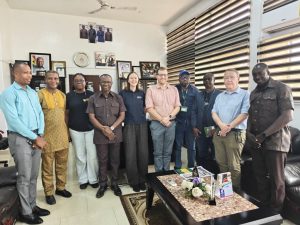
A stakeholder consultation workshop follows on 9 September at CSIR-CRI, bringing together farmers, extension officers, policymakers and development partners, with a field visit to see the instruments in the ground.

Burning clears the field in an afternoon, but the cost goes into the air and out of the soil. This project lets us show farmers what they get back when they leave the residue where it fell.” Said Dr. Kwaku Onwona-Hwesofour Asante, ACE4ES PI and CO-PI for the Ghana Agrogeophysics Program.

Story by:

Nana Yaw Reuben

Latest stories