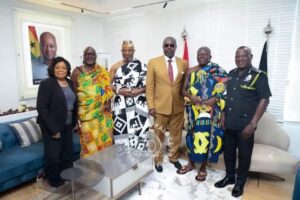
The Asantehene, Otumfuo Osei Tutu II, has underscored the importance of aligning cultural values with formal legal systems as a more effective approach to crime prevention and social order.
According to him, communities grounded in strong cultural norms make the work of law enforcement easier, while societies that abandon their traditions place the entire burden of maintaining peace and order on the police.
Otumfuo Osei Tutu II made these remarks on Tuesday, January 6, during a historic visit to the National Police Headquarters in Accra, where he was received with a ceremonial parade by officers of the Ghana Police Service.
During the visit, the Asantehene commended the Police Service for its dedication to protecting lives and property across the country, describing the relationship between traditional authorities and law enforcement as a long-standing partnership essential to national stability.
Highlighting the foundational role of custom in governance, Otumfuo noted that culture predates modern legal systems and remains vital in shaping responsible behavior within communities.
“Before courts were built, disputes were settled. Before statutes were written, wrong was already understood. Custom was the first law. Culture was the first constitution. It taught restraint before punishment, responsibility before rights, and harmony before victory,” he stated.
He cautioned, however, that neither culture nor law can function effectively in isolation. “Culture without law becomes nostalgia—beautiful stories with no teeth. Law without culture becomes force—effective but brittle. One shapes the heart; the other restrains the hand,” he added.
The Asantehene therefore called for deeper collaboration between traditional authorities and the Ghana Police Service, urging that police officers be trained to understand local customs and to prioritise dialogue and mediation over confrontation in resolving conflicts.
He expressed confidence that integrating cultural wisdom with legal enforcement would help build safer, more cohesive communities across Ghana.